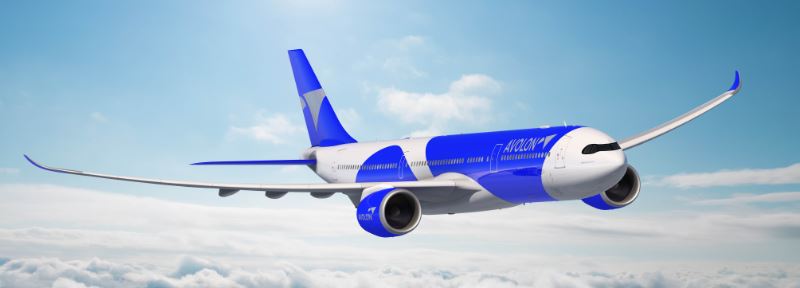
The new venture will acquire 22 aircraft valued at $1.4 billion. Photo: Avolon.
DUBLIN – Aircraft lessor Avolon said Monday that it will establish a new leasing platform with Miami-based infrastructure investor I Squared Capital and a subsidiary of Abu Dhabi Investment Authority, backed by a $1.4 billion seed portfolio.
The new joint venture, named Constellation Aviation, will use the seed funding to acquire 22 aircraft from Avolon. The aircraft have an average age of about five years and are leased to 17 airlines in 15 countries.
Avolon will retain a minority stake in the venture and serve as its exclusive aircraft manager and servicer, providing leasing, asset management and technical expertise, the Dublin-based company said.
The platform is expected to expand over time, capitalizing on growing passenger demand, limited aircraft manufacturing capacity and airlines’ increasing reliance on leasing to finance fleet expansion and renewal, Avolon said.
In October, Avolon placed firm orders for 250 aircraft from Boeing and Airbus, with options for a further 100 Airbus jets. The orders increased its total firm aircraft commitments to 749.
The DHC-515, marketed as the Canadair 515, is a new version of the Canadair CL-415 amphibious waterbomber. It builds on the legacy of the CL-415 with modern avionics, improved maintainability and enhanced operational capabilities.
De Havilland Canada is producing an initial batch of 22 DHC-515s for six European customers: Croatia, Spain, Italy, Greece, Portugal and France. Purchase agreements for the aircraft were signed through the Canadian Commercial Corp. in 2024.
Assembly of the first DHC-515 is under way at the company’s Canadian manufacturing facilities. In a production update in July, the company said the cockpit and hull had been joined to form the forward fuselage, while the mid-fuselage and the aircraft’s first 28.6-metre wing box had also been completed.
The financing agreement will allow the company to accelerate production, with additional aircraft slots expected to become available starting in 2030.
The company also plans to hire more staff and expand capacity at its sites in Victoria, Calgary, Toronto, Kitchener and Fort Erie, Ont.
The transaction is expected to be completed in the first quarter of 2027.
Demand for waterbombers has increased in recent years amid catastrophic wildfires in various parts of the world.
In August, the Canadian government reached a conditional agreement with British Columbia-based Coulson Aviation to convert 10 retired Royal Canadian Air Force CC-130H Hercules transport aircraft into aerial firefighters.
Canada had 129 active wildfires as of Saturday, including 11 classified as out of control, according to the Canadian Wildland Fire Information System. Year to date, 5,560 fires had burned 4.5 million hectares, the platform’s data showed.
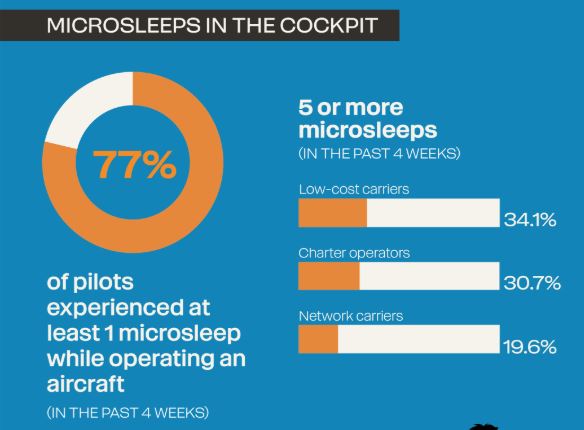
BRUSSELS – More than three-quarters (77%) of European pilots surveyed experienced at least one microsleep while operating an aircraft in the past four weeks, according to a report released Monday by the European Cockpit Association.
The survey, conducted by aviation consultancy Baines Simmons and based on responses from 7,200 pilots across 32 countries, found little improvement in fatigue risk management since a similar study in 2023.
Despite widespread fatigue, only 37.2% of pilots said they reported being unfit to fly because of fatigue, while 24.2% said they did not report it and flew anyway.
In written responses, 38.2% cited fear of punishment or retaliation for submitting a fatigue report, while 46.9% said concerns about management’s reaction had contributed to flying while fatigued.
The survey also found continued pressure to extend flight duties under Commander’s Discretion, a provision intended to permit extensions in exceptional circumstances. Some 38.3% of pilots said they had used it at least once in the previous four weeks, while 15.2% had used it twice or more.
Meanwhile, 69.1% expressed some degree of concern about negative consequences if they refused to extend a flight duty, up from 65.8% in 2023.
Capt. Tanja Harter. Photo: ECA.
ECA President Capt. Tanja Harter said the findings should prompt airlines, regulators and the European Union Aviation Safety Agency to change how pilot fatigue is managed.
“This report provides all the data needed to repair Europe’s broken fatigue reporting, to strengthen EASA regulations to ensure airlines proactively manage their fatigue risks, and to enforce once and for all the requirement for non-punitive fatigue reporting and use of Commander’s Discretion to extend a flight.”
The association said fatigue reporting systems at many airlines were not considered effective or trustworthy and called for stronger oversight by national aviation authorities and measures to ensure pilots could report fatigue without fear of punishment.
The findings were reported as the EASA was finalizing a strategy on aircrew fatigue and setting priorities for the coming years.
Baines Simmons Managing Director Ian Holder said the survey reflected pilots’ experiences rather than directly measuring safety risks or outcomes.
However, he said the consistency of the findings over three years highlighted areas where airlines and regulators could focus their efforts.
The Wichita facility is Bombardier’s first dedicated in-house skills development center. Photo: Bombardier.
WICHITA, Kan. – Bombardier opened its North American Learning Center in Wichita on Thursday, part of a new $50 million investment by the Canadian business aircraft maker, less than six weeks after President Donald Trump threatened to block the company from selling aircraft in the United States unless they are built in America.
Bombardier has pushed back against the rhetoric, saying it employs thousands of Americans and supports tens of thousands of U.S. jobs through its operations and supply chain. The company spends more than $2.5 billion annually with U.S. suppliers.
The learning center will provide specialized training for newly hired aircraft technicians and mechanics who will support customers through Bombardier’s American service network. It is the company’s first dedicated in-house skills development center.
The investment also includes a recently expanded Wheel and Tire Shop, which uses specialized equipment and employee training to expand the company’s component repair and overhaul capabilities.
Bombardier said the projects will strengthen its U.S. operations and position the Kansas site for continued growth.
“Wichita has long been an important part of Bombardier’s story, and we continue to see tremendous opportunity for the site,” said Paul Sislian, executive vice president of aircraft sales and Bombardier Aftermarket Services.
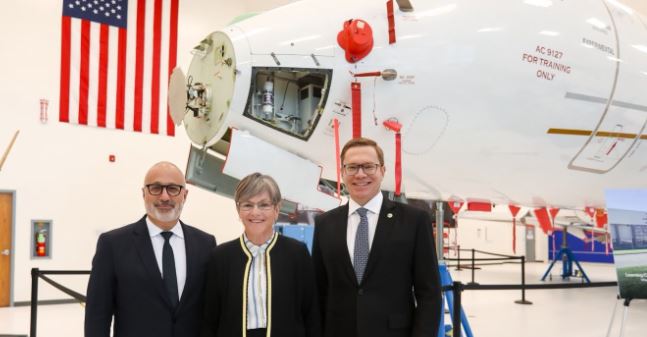
The inauguration ceremony was attended by Kansas Gov. Laura Kelly, Lt.-Gov. David Toland, Bombardier executives and industry representatives.
Kelly said her administration had partnered with Bombardier since 2019 to expand its presence in Wichita, which is home to the company’s U.S. headquarters and Bombardier Defense.
The company has about 3,500 employees and 10 service and manufacturing facilities across the country. It is also planning to open a service center in Fort Wayne, Ind.
The Global 8000 will be among Bombardier aircraft on display: Photo: Bombardier.
At NBAA-BACE, the business aviation industry’s largest convention, opening in Las Vegas on Tuesday, Bombardier will put its Global 8000, Global 6500 and Challenger 3500 aircraft on static display.
The company will also host a discussion with John Travolta. The actor, who is type-rated on more than a dozen aircraft, including the Global Express, will share experiences from his 50 years of flying.
The Citation CJ3 Gen2 offers seating for up to 10 occupants. Photo: Textron Aviation.
WICHITA, Kan. –Textron Aviation will debut its Cessna Citation CJ3 Gen2 light jet at NBAA-BACE, the business aviation industry’s largest convention opening in Las Vegas next Tuesday, the company said Wednesday.
Textron Aviation manufactures Cessna and Beechcraft aircraft.
The static display at Henderson Executive Airport on Oct. 20-21 will also feature the Citation Longitude, Citation Latitude and Citation Ascend, the company said.
In addition, Textron Aviation will showcase aftermarket services, connectivity solutions and cabin upgrades at the event.
TRU Simulation + Training, an affiliate of the company, will demonstrate its Veris virtual reality flight training device configured for the Cessna Skyhawk.
The Citation CJ3 Gen2 features Garmin autothrottle technology, Garmin G3000 avionics and GDL60 connectivity, Textron Aviation said.
The aircraft can accommodate up to 10 occupants and offers optional swivel seats. It has a range of 2,040 nautical miles with a maximum payload of 2,135 pounds.
The 2026 NBAA-BACE will be held Oct. 20-22 at the Las Vegas Convention Center.
Airbus projects the industry will need 2.44 million additional aviation professionals over the next 20 years. Photo: Airbus.
TOULOUSE, France – The global aviation services market is expected to double in value to $422 billion by 2045, driven by fleet expansion and growing demand for maintenance, digital solutions and workforce training, Airbus said Wednesday.
The market will grow at a compound annual rate of 3.8% from $209 billion in 2026, supporting a commercial aircraft fleet of more than 45,550 aircraft and nearly 10 billion annual passenger journeys by 2045, according to the European aircraft manufacturer’s Global Services Forecast.
The industry will need 2.44 million additional aviation professionals over the next 20 years, including 730,000 maintenance technicians, 660,000 pilots and 1.05 million cabin crew members, the report said.
Off-wing maintenance, including engine and component repairs, will account for the largest share of the market, reaching $217 billion by 2045. Digital services and connectivity will be the fastest-growing segment, expanding at an annual rate of 5.3% to $27 billion.
Airbus expects Europe and the Commonwealth of Independent States, North America and China to remain among the largest services markets. Asia is projected to record the fastest growth.
The forecast covers passenger aircraft with more than 100 seats and freighters with payload capacities exceeding 10 tonnes, regardless of manufacturer, Airbus said.
Boeing, in a separate report released in July, projected the global commercial aviation support and services market would reach $4.9 trillion over the next 20 years.
The American manufacturer also estimated the industry would need more than 2.4 million new aviation personnel by 2045, with about two-thirds of the demand replacing retiring workers.
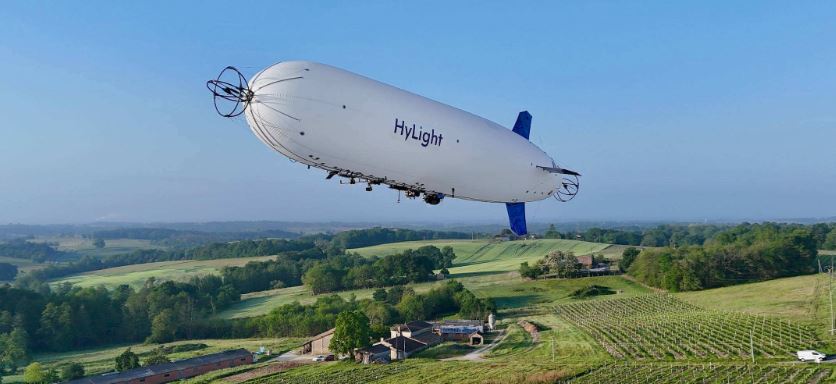
The airships have completed over 750 flight hours. Photo: HyLight.
PARIS – French startup HyLight has raised €13 million (US$15 million) to expand its fleet of autonomous, hydrogen-powered airships used for infrastructure inspections as it seeks to replace helicopter missions across Europe, the company said Monday.
Founded in 2022, HyLight said its aircraft have completed more than 750 flight hours and inspected thousands of kilometers of infrastructure across Europe. Its customers include energy companies Enedis, NaTran and Téréga, railway operator SNCF Réseau and construction group VINCI.
The company plans to increase the number of aircraft it operates simultaneously from four to 15 by 2027. The funding will support production, artificial intelligence development, recruitment and expansion into European markets, particularly Germany and the Netherlands, HyLight said.
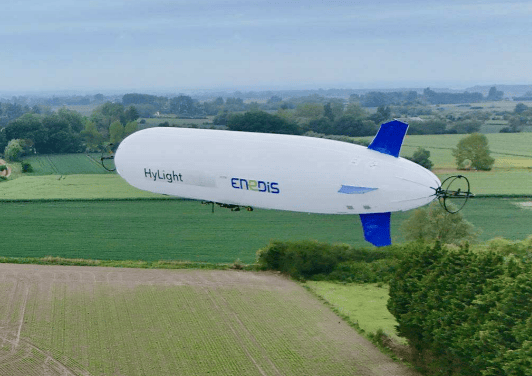
The airships are powered by hydrogen. Photo: HyLight.
The 12-meter-long HyLighter uses hydrogen to power its electric propulsion system and can fly for up to 10 hours, with a target range of 350 kilometers.
It can carry up to 10 kilograms of equipment, including cameras, LiDAR sensors and methane detectors.
HyLight’s software can identify and geolocate more than 50 types of infrastructure defects and vegetation-related risks, helping maintenance teams prioritize repairs, it said.
Helicopters remain widely used to inspect power lines, pipelines and railways, despite their operating costs and emissions.
TOULOUSE, France –Irish aircraft lessor Avolon has placed a firm order for 110 Airbus aircraft, comprising 35 A330-900 widebodies and 75 A320neo family narrowbodies, the European manufacturer said.
No financial details were disclosed.
The deal increases Avolon’s total orders for the A330-900 to 114 aircraft and its A320 family orders to about 650.
Avolon CEO Andy Cronin said the order would strengthen the company’s delivery pipeline and help it meet customers’ fleet expansion and replacement needs into the next decade.
The company expects demand for both the A330neo and A320neo to remain strong as the aviation sector continues to grow, Cronin said.
Airbus said the A330neo, powered by Rolls-Royce Trent 7000 engines, can fly up to 8,100 nautical miles (15,000 kilometers) nonstop and offers 25% lower fuel consumption, carbon dioxide emissions and operating costs than previous-generation competitor aircraft.
Avolon is the world’s third-largest aircraft lessor, after AerCap and SMBC Aviation Capital. All three are headquartered in Dublin.
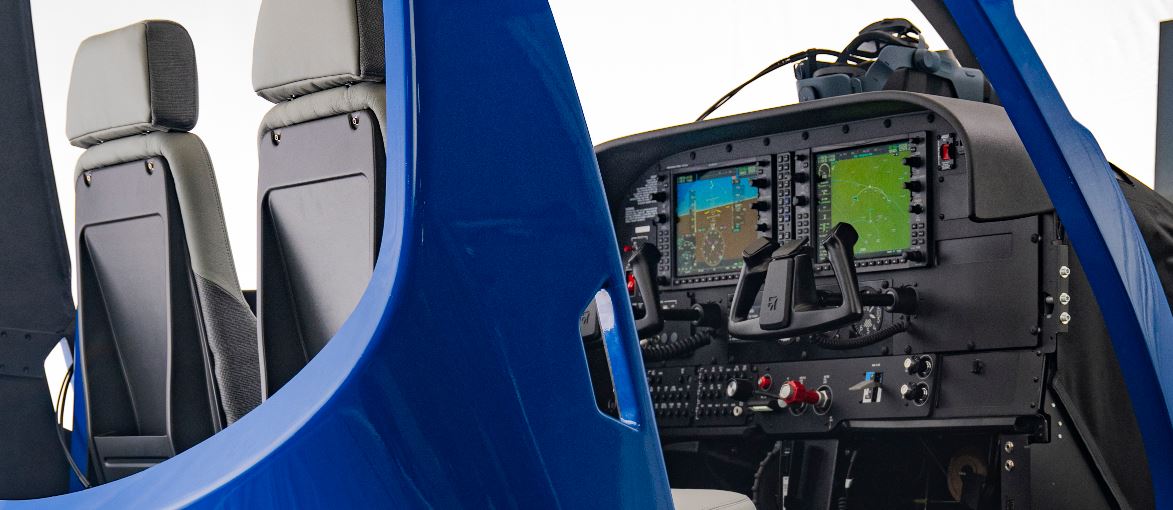
The Veris simulator was developed for the Cessna Skyhawk training aircraft. Photo: TRU Simulation.
TAMPA, Fla. – Visitors to this month’s National Business Aviation Association‘s convention and exhibition in Las Vegas will be able to experience the Veris Virtual Reality Flight Training Device as it makes its debut at the show, the company behind the simulator said Monday.
The Cessna Skyhawk Veris combines VR technology with flight simulator features and has a fully configured cockpit that replicates the Skyhawk’s instrumentation and controls, the company said.
It also incorporates Garmin G1000 NXi avionics and can be used with or without a virtual reality headset.
The Cessna Skyhawk. Photo: Textron Aviation.
The device has two seats, allowing instructors and students to train together and pilots to conduct training from either the left or right seat. It is designed to support training from the private pilot through flight instructor levels.
The device’s debut follows a purchase agreement announced at NBAA-BACE 2025 with US Aviation Academy for five Cessna Skyhawk Veris devices, with options for additional units.
The 2026 NBAA-BACE will be held Oct. 20-22 at the Las Vegas Convention Center.
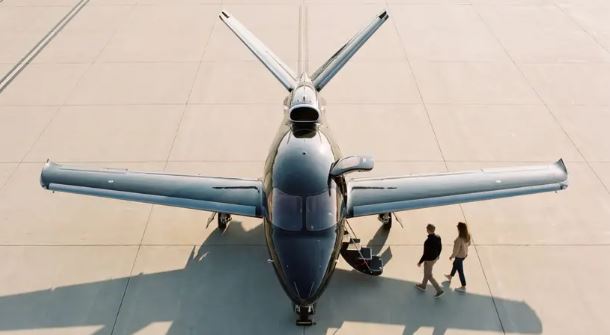
Flyte Aviation is operating a fleet of Cirrus Vision Jets. Photo: Flyte Aviation.
NEW YORK – Medical device company Catheter Precision has rebranded as Flyte Aviation, effective Monday, following its acquisition of the private charter business Fly Flyte earlier this year.
The company also changed its NYSE ticker from VTAK to VJET. The rebranding reflects its shift toward aviation and technology, the company said Sunday.
Catheter Precision acquired Fly Flyte as part of a move into private aviation and is now building its business around a digital platform designed to simplify the discovery, pricing and booking of private aircraft.
Flyte said the U.S. private jet charter market is worth about $11.6 billion in 2026 and is expected to grow at an annual rate of 6.9% through 2031, citing a September report by Fortune Business Insights.
During the fourth quarter, the company plans to invest in a mobile application, AI data analytics and customer acquisition as it expands its aviation business.
Flyte also said its existing life sciences operations, which include the LockeT and VIVO products, will continue and that it remains committed to funding ongoing research trials and studies.
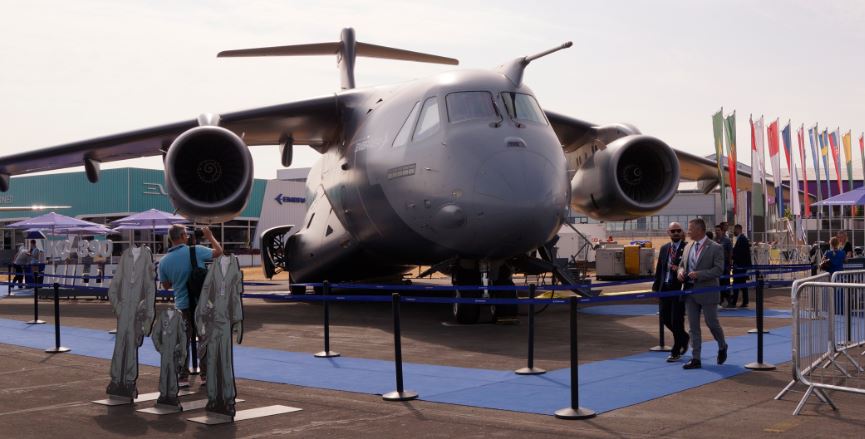
The Embraer KC-390 Millennium on display at the Farnborough International Airshow in July. Photo: Abdul Latheef.
SAO PAULO –Embraer delivered 66 aircraft in the third quarter, its best three-month delivery performance ever, the Brazilian aerospace company said Friday.
Deliveries rose 2% from the second quarter and 6% from a year earlier, Embraer said.
In the first nine months of 2026, the company delivered 175 aircraft, up 14% from 153 in the same period last year, supported by progress in its production leveling initiatives.
Commercial Aviation delivered 22 aircraft in the quarter, comprising 11 E175s and 11 E2-family aircraft, up 10% from both the previous quarter and a year earlier.
Executive Aviation delivered 41 business jets, unchanged from a year earlier, while Defense & Security delivered one KC-390 Millennium military transport aircraft and two A-29 Super Tucanos.
Embraer expects to deliver 80 to 85 commercial aircraft and up to 170 business jets this year.
In July, Embraer reported a record $34.5 billion backlog in the second quarter, up 7% from the previous period and 16% from a year earlier, marking its seventh consecutive quarterly increase.
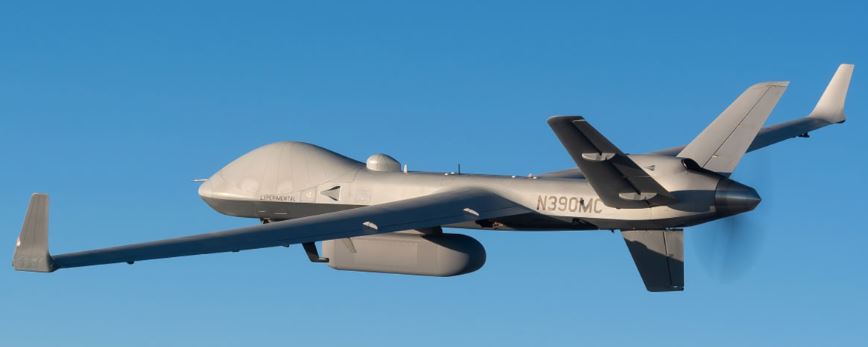
SAN DIEGO – Unmanned aircraft manufacturer General Atomics Aeronautical Systems said Thursday it has tested a communications pod that allows its MQ-9B drone to restore connectivity in areas affected by natural disasters.
The Disaster Relief Unit communications system was developed by Japanese telecommunications and technology company SoftBank Corp.
The system allows the MQ-9B to serve as a mobile network relay tower in the sky, providing connectivity where cellular towers have been damaged, such as by floods or other natural disasters, General Atomics said.
The MQ-9B family comprises multi-mission uncrewed aircraft that can operate in all weather conditions. The aircraft are being flown by operators in several countries.
The MSN 700 flew for 4 hours and 10 minutes. Photo: Airbus.
TOULOUSE, France – The freighter version of the Airbus A350 completed its first flight Tuesday, beginning a more than nine-month flight-test campaign for the new cargo aircraft, the European manufacturer said.
The first of two test aircraft, MSN 700 flew for 4 hours and 10 minutes, reaching an altitude of 25,000 feet. The aircraft was equipped with flight-test instrumentation and flown by an Airbus flight-test crew.
During the flight, the crew conducted tests to verify the aircraft’s basic airworthiness, flying qualities and system performance.
The second A350F test aircraft, MSN 701, is in the final stages of assembly and is expected to enter the paint shop in the coming weeks.
The A350F has a range of up to 8,700 kilometers and a maximum payload of 111 metric tons, according to Airbus. The aircraft is powered by Rolls-Royce Trent XWB-97 engines and uses more than 70% advanced materials.
Airbus said the A350F will have a maximum takeoff weight 46 metric tons lower than competing aircraft and will consume up to 40% less fuel and produce up to 40% fewer carbon emissions than freighters with similar payload and range capabilities.
As of the end of August, Airbus had recorded 115 A350F orders from 14 disclosed customers, giving it as much as 59% of the large-freighter market, according to the company.
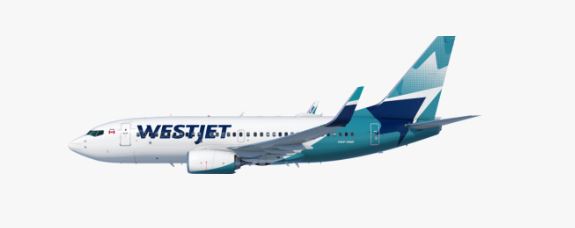
WestJet said the deal marks the start of the retirement of its 737-700 fleet. Photo: WestJet.
NEW YORK – Canadian airline WestJet has begun retiring its Boeing 737-700 fleet with the sale of 27 aircraft to lessor FTAI Aviation Ltd., including 17 in a sale-leaseback transaction, FTAI said Monday. Ten airplanes will be off lease.
WestJet currently lists 30 Boeing 737-700s in its fleet, meaning the transaction covers all but three of the type.
The 10 off-lease aircraft will support FTAI’s Aerospace Products business by expanding its supply of CFM56-7B engines and modules for its maintenance, repair and exchange customers, the company said.
FTAI added that the transaction is one of its largest aircraft acquisitions to date and combines its airplane ownership business with its engine maintenance capabilities.
“We are pleased to expand our relationship with WestJet through this transaction,” FTAI President David Moreno said.
WestJet Group Executive Vice President and Chief Financial Officer Mike Scott said the transaction marks the start of the airline’s retirement of its 737-700 fleet.
“We’re pleased to partner with FTAI Aviation Ltd. to make this happen, and we look forward to building on this relationship for future opportunities,” Scott said.
TOYOTA CITY, Japan –SkyDrive has published a paper making the case for compact eVTOLs designed for urban transportation, arguing that such aircraft should prioritize efficient hovering and vertical operations over long-range cruise performance.
The Japanese company says its approach is particularly suited to flights of less than 30 kilometers, where aircraft would spend a significant portion of their missions taking off, landing and hovering in confined urban areas.
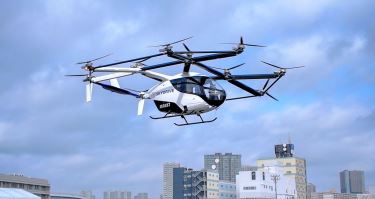
SkyDrive is developing a three-seat eVTOL called the SD-05 with 12 independently controlled propellers for such operations.
The design differs from winged eVTOLs and tilt-rotor aircraft, which can use their wings to improve efficiency during forward flight. Those configurations also require additional structures and mechanisms to support the transition between vertical and forward flight, adding weight and complexity, SkyDrive said.
The SD-05. Photo: SkyDrive.
For short urban flights, the company argues that the additional weight provides less benefit because the aircraft spends relatively little time in cruise.
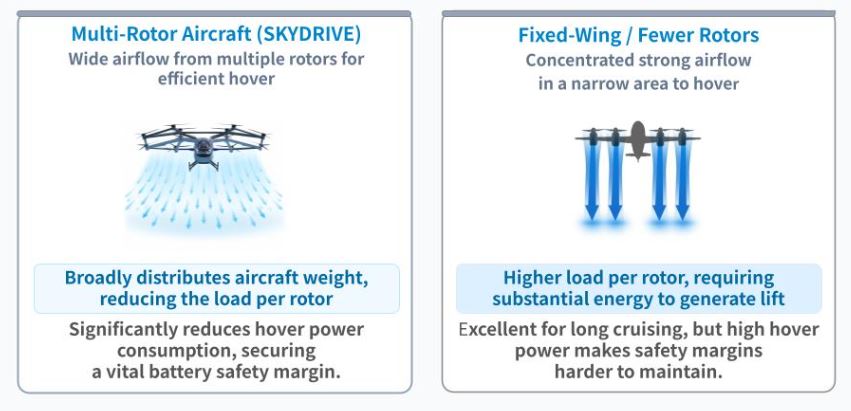
Instead, SkyDrive has designed its aircraft around what it calls a low-disk-loading configuration.
Disk loading is a measure of how much weight an aircraft must support for a given area of rotor. A larger rotor area relative to the aircraft’s weight reduces the power required to hover.
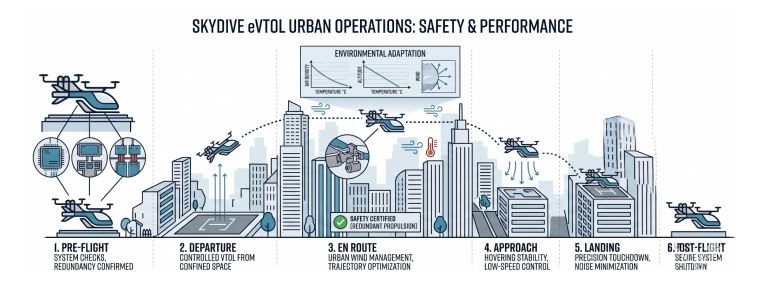
SkyDrive says that lower power requirement is important in cities because it provides additional power capacity during takeoff, landing and emergency situations.
Graphic: SkyDrive.
The aircraft also uses four separate battery systems, providing another layer of redundancy. SkyDrive says the combination of distributed propulsion and lower power requirements helps maintain a power margin for hovering and landing in contingency situations.
The company also noted that compact aircraft require less space for takeoff and landing, an important consideration in built-up areas.
SkyDrive’s focus on short-distance operations is also reflected in its recent international plans.
Last week, the company signed a memorandum of understanding with South Korea’s Verty to study commercial eVTOL operations in the country by 2028. The companies plan to examine sightseeing flights, including around Jeju Island, as well as regional routes around the Seoul metropolitan area.