TOYOTA CITY, Japan – SkyDrive has published a paper making the case for compact eVTOLs designed for urban transportation, arguing that such aircraft should prioritize efficient hovering and vertical operations over long-range cruise performance.
The Japanese company says its approach is particularly suited to flights of less than 30 kilometers, where aircraft would spend a significant portion of their missions taking off, landing and hovering in confined urban areas.
SkyDrive is developing a three-seat eVTOL called the SD-05 with 12 independently controlled propellers for such operations.
The design differs from winged eVTOLs and tilt-rotor aircraft, which can use their wings to improve efficiency during forward flight. Those configurations also require additional structures and mechanisms to support the transition between vertical and forward flight, adding weight and complexity, SkyDrive said.

For short urban flights, the company argues that the additional weight provides less benefit because the aircraft spends relatively little time in cruise.
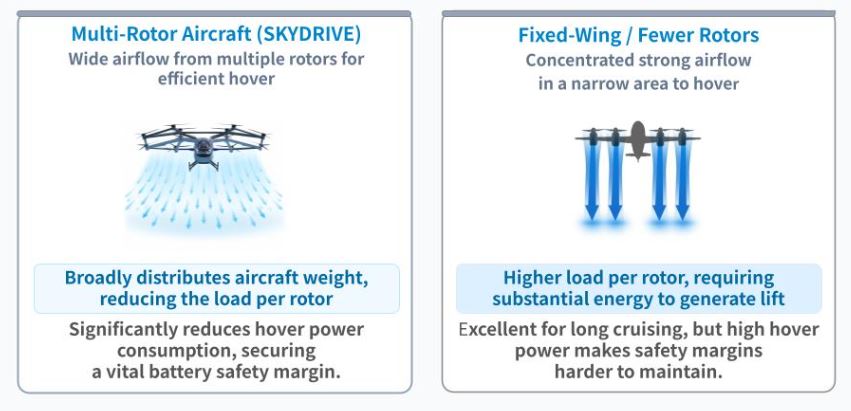
Instead, SkyDrive has designed its aircraft around what it calls a low-disk-loading configuration.
Disk loading is a measure of how much weight an aircraft must support for a given area of rotor. A larger rotor area relative to the aircraft’s weight reduces the power required to hover.
SkyDrive says that lower power requirement is important in cities because it provides additional power capacity during takeoff, landing and emergency situations.
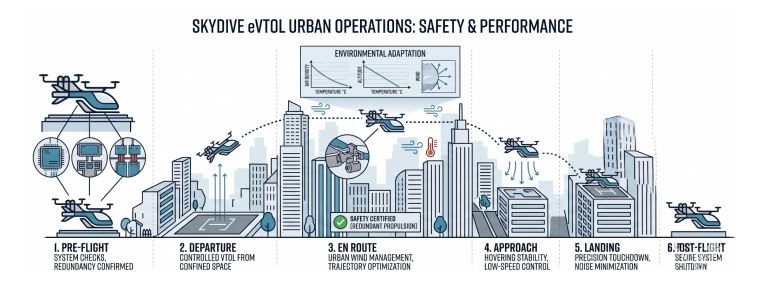
The aircraft also uses four separate battery systems, providing another layer of redundancy. SkyDrive says the combination of distributed propulsion and lower power requirements helps maintain a power margin for hovering and landing in contingency situations.
The company also noted that compact aircraft require less space for takeoff and landing, an important consideration in built-up areas.
SkyDrive’s focus on short-distance operations is also reflected in its recent international plans.
Last week, the company signed a memorandum of understanding with South Korea’s Verty to study commercial eVTOL operations in the country by 2028. The companies plan to examine sightseeing flights, including around Jeju Island, as well as regional routes around the Seoul metropolitan area.