
GENEVA – Global air passenger traffic returned to growth in July after three consecutive months of contraction, although the recovery was modest as the industry continued to feel the effects of the Iran war, according to the International Air Transport Association.
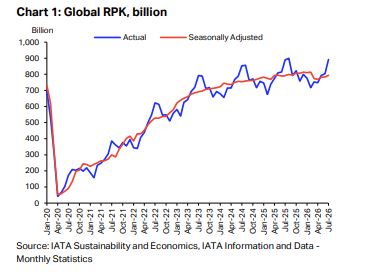
Passenger traffic, measured in revenue passenger-kilometers, rose 0.2% from a year earlier, IATA said Monday. The increase followed declines in April, May and June.
Airlines added 0.3% more capacity in July, while the global passenger load factor slipped 0.1 percentage point from a year earlier to 85.2%.
International passenger demand fell 0.1% year over year, while domestic traffic increased 0.6%. Excluding carriers in the Middle East, international demand would have increased 1.5%, IATA said.
“Overall growth of 0.2% in July was achieved despite year-on-year collective declines by carriers in North America and the Middle East,” IATA Senior Vice President and Chief Economist Marie Owens Thomsen said.
She said traffic through Gulf hubs continued to recover, while airlines remained confident about demand despite high fuel prices, economic uncertainty and geopolitical tensions.
Airlines are planning to increase seat capacity by almost 3% in September, IATA said.
Regional results varied widely. European airlines recorded a 3.1% increase in international demand, while Latin American and African carriers posted gains of 7.1% and 6.4%, respectively.

North American carriers reported a 2.3% decline in international demand, while Middle Eastern airlines saw demand fall 9.5%. Asia-Pacific carriers recorded a 0.7% decline.
Passenger traffic between Europe and Asia grew 12.1%, the strongest increase among major international routes, according to IATA.
Domestic traffic rose 0.6% globally, with China and Brazil posting strong gains. Demand declined in the United States, Australia and India.
IATA represents more than 370 airlines that account for about 85% of scheduled air traffic.